Available Number of Questions: Maximum of
382 Questions
Exam Name: BA2 - Fundamentals of Management Accounting
Exam Duration: 120 Minutes
Related Certification(s):
CIMA Certificate in Business Accounting Certification
CIMA CIMAPRA17-BA2-1 Exam Topics - You’ll Be Tested in Actual Exam
The CIMA CIMAPRA17-BA2-1 exam assesses your knowledge and skills in strategic business reporting and performance management. It covers a range of essential topics that are crucial for aspiring management accountants. These topics include the principles and practices of strategic business reporting, which involve generating and presenting financial and non-financial information to support decision-making and strategic planning. The exam also delves into performance management, emphasizing the importance of setting key performance indicators (KPIs), monitoring performance, and implementing corrective actions to achieve organizational goals. Financial analysis is another key area, focusing on interpreting financial statements, conducting ratio analysis, and evaluating financial performance to make informed business decisions. Additionally, the exam explores risk assessment and management, teaching candidates how to identify, assess, and mitigate risks to ensure the long-term success and sustainability of an organization. Furthermore, it covers budgeting and forecasting techniques, enabling candidates to develop effective financial plans and make accurate predictions. The CIMAPRA17-BA2-1 exam also emphasizes the role of technology in business reporting and performance management, including the use of ERP systems and data analytics tools. Lastly, it explores the ethical and professional considerations in management accounting, ensuring that candidates understand their responsibilities and adhere to ethical standards.
CIMA CIMAPRA17-BA2-1 Exam Short Quiz
Attempt this CIMA CIMAPRA17-BA2-1 exam quiz to self-assess your preparation for the actual CIMA BA2 - Fundamentals of Management Accounting exam. CertBoosters also provides premium CIMA CIMAPRA17-BA2-1 exam questions to pass the CIMA BA2 - Fundamentals of Management Accounting exam in the shortest possible time. Be sure to try our free practice exam software for the CIMA CIMAPRA17-BA2-1 exam.
1of 0 questions |
CIMA CIMAPRA17-BA2-1 Exam Quiz
✓ 0 answered
🔖 0 bookmarked
CIMACIMAPRA17-BA2-1
Q1:
Which THREE of the following are parts of the master budget? (Choose three.)
☐
AFinished goods inventory budget.
☐
BBudgeted statement of profit or loss.
☐
CCash flow budget.
☐
DSales budget.
☐
EAdministration overhead budget.
☐
FBudgeted statement of financial position.
CIMACIMAPRA17-BA2-1
Q2:
Which type of budget would be the most suitable for a cash budget?
○
AFixed budget
○
BRolling budget
○
CIncremental budget
○
DFlexible budget
CIMACIMAPRA17-BA2-1
Q3:
Assume that a unit of output is the cost object. Which of the following statements is valid?
○
ARoyalties paid on per unit basis are an example of an indirect expense.
○
BMaterials consumed in the maintenance of machinery used to manufacture several different products are an example of a direct material cost.
○
CThe salaries of supervisors who oversee the manufacture of several different products are an example of a direct labour cost.
○
DRent paid for a factory in which several different products are produced is an example of an indirect expense.
CIMACIMAPRA17-BA2-1
Q4:
The following data relate to the latest period.
A statement is to be prepared that reconciles the difference between the flexible budget profit and the actual profit.
Which TWO of the following will appear on this statement? (Choose two.)
☐
AA favourable labour rate variance.
☐
BA favourable sales volume contribution variance.
☐
CAn adverse sales price variance.
☐
DAn adverse labour efficiency variance.
☐
EAn adverse material price variance.
CIMACIMAPRA17-BA2-1
Q5:
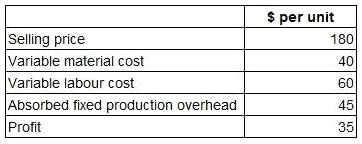
A company makes and sells a range of products. The standard details per unit for one of these products, product X, are as follows.
To meet sales demand, the company must obtain 2,000 units of product X next month. There is sufficient labour capacity to produce 1,500 of these units in-house during normal time. However, any production above this level would require overtime working which would be paid at a premium of 50%.
The company can buy as many units of product X as it wishes next month from an external supplier at a price of $120 per unit.
What is the total financial benefit to the company of purchasing the appropriate number of units from the external supplier rather than producing them in-house?