Available Number of Questions: Maximum of
60 Questions
Exam Name: Conducting Threat Hunting and Defending using Cisco Technologies for Cybersecurity
Related Certification(s):
Cisco CCNP, Cisco Certified Network Professional Cybersecurity Certifications
Cisco 300-220 Exam Topics - You’ll Be Tested in Actual Exam
You need to be ready to think like a hunter, not a ticket closer. This exam keeps pulling you back to why you are hunting in the first place, because threat hunting outcomes are not vague wins but specific findings you can defend, scope, and communicate. From there, it tests whether you can run a threat hunting process that stays disciplined when the data is messy, starting with a clear hypothesis, choosing what evidence would prove or disprove it, and knowing when to stop digging. Threat Hunting Fundamentals matter, but mostly as the baseline for making good calls under uncertainty, like what counts as normal behavior and what is just noise. A lot of the real scoring comes from how you apply threat hunting techniques in context, tying your searches to a threat model rather than chasing random indicators, and understanding how modeling techniques shape what you look for and in what order. Attribution techniques show up as a reality check. You are not expected to play detective for fame, but you do need to reason through actor patterns, tradecraft, and confidence levels without overclaiming. The common trap is treating the process like a checklist and forgetting that each step should narrow the next question, so practice writing tighter hypotheses and deciding what evidence would actually change your mind.
Cisco 300-220 Exam Short Quiz
Attempt this Cisco 300-220 exam quiz to self-assess your preparation for the actual Cisco Conducting Threat Hunting and Defending using Cisco Technologies for Cybersecurity exam. CertBoosters also provides premium Cisco 300-220 exam questions to pass the Cisco Conducting Threat Hunting and Defending using Cisco Technologies for Cybersecurity exam in the shortest possible time. Be sure to try our free practice exam software for the Cisco 300-220 exam.
1of 0 questions |
Cisco 300-220 Exam Quiz
✓ 0 answered
🔖 0 bookmarked
Cisco300-220
Q1:
While investigating multiple incidents, analysts notice that attackers consistently use SMB for lateral movement and avoid PowerShell execution. Why is this observation valuable for attribution?
○
AIt identifies the exploit used for initial access
○
BIt reveals the attacker's malware development framework
○
CIt highlights consistent attacker tradecraft
○
DIt confirms data exfiltration techniques
Cisco300-220
Q2:
A SOC analyst using Cisco security tools wants to differentiate threat hunting from traditional detection engineering. Which activity BEST represents threat hunting rather than detection engineering?
○
ACreating a SIEM rule to alert on known malicious domains
○
BTuning EDR alerts to reduce false positives
○
CFormulating a hypothesis to search for credential misuse without alerts
○
DBlocking IP addresses based on Talos intelligence
Cisco300-220
Q3:
A security analyst receives an alert that host A, which has an IP address of 192.168.5.39, has a new browser extension installed. During an investigation of the SIEM tool logs, the analyst discovers that host A made continuous TCP connections to an IP address of 1.25.241.8 via TCP port 80. The 1.25.241.8 IP address is categorized as a C2 server. Which action should the analyst take to mitigate similar connections in the future?
○
AConfigure a browser extension deny list.
○
BUse antivirus software to quarantine suspicious files automatically.
○
CUse Deep Packet Inspection to block malicious domains.
○
DUse IDS to detect and avoid similar connections.
Cisco300-220
Q4:
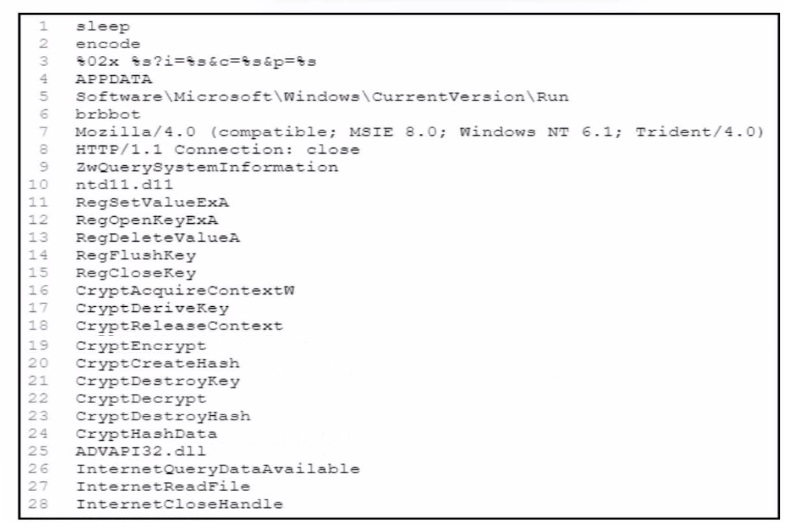
Refer to the exhibit.
A security engineer notices that a Windows Batch script includes calls to suspicious APIs. How will the script affect the system when it is executed?
○
AThe internet connection is disabled.
○
BThe host version is retrieved.
○
CThe host is put in sleep mode.
○
DFiles are encrypted.
Cisco300-220
Q5:
A threat hunter is asked to model how an attacker could abuse cloud identity misconfigurations to escalate privileges without exploiting software vulnerabilities. Which modeling approach BEST supports this analysis?
○
ASTRIDE focused on spoofing and elevation of privilege
○
BKill Chain analysis focused on malware execution
○
CAttack path analysis using identity relationships