Databricks Machine Learning Professional Exam Info
Skill Up with Our
Databricks Machine Learning Professional
EXAM QUIZ
Databricks Machine Learning Professional Exam Questions
Exam number/code:
Databricks Machine Learning Professional
Release/Update Date:
04 Aug, 2026
Available Number of Questions: Maximum of
60 Questions
Exam Name: Databricks Certified Machine Learning Professional
Exam Duration: 120 Minutes
Related Certification(s):
Databricks Machine Learning Professional Certification
Databricks Machine Learning Professional Exam Topics - You’ll Be Tested in Actual Exam
The Databricks Machine Learning Professional exam covers a range of topics essential for mastering machine learning on the Databricks platform. You'll delve into the fundamentals of machine learning, exploring concepts like supervised and unsupervised learning, model training, and evaluation. The exam also emphasizes the practical aspects of machine learning, such as data preparation, feature engineering, and model deployment. Additionally, you'll learn about advanced techniques like hyperparameter tuning, model interpretability, and handling imbalanced datasets. Databricks-specific tools and libraries, including MLflow and Delta Lake, are also covered, enabling you to leverage their capabilities for efficient model development and management. Furthermore, the exam tests your understanding of model monitoring and improvement, ensuring you can optimize and refine your machine learning models over time. Finally, you'll explore the integration of machine learning with other technologies, such as data engineering and data science workflows, to create end-to-end solutions.
Databricks Machine Learning Professional Exam Short Quiz
Attempt this Databricks Machine Learning Professional exam quiz to self-assess your preparation for the actual Databricks Certified Machine Learning Professional exam. CertBoosters also provides premium Databricks Machine Learning Professional exam questions to pass the Databricks Certified Machine Learning Professional exam in the shortest possible time. Be sure to try our free practice exam software for the Databricks Machine Learning Professional exam.
1of 0 questions |
Databricks Machine Learning Professional Exam Quiz
✓ 0 answered
🔖 0 bookmarked
DatabricksDatabricks Machine Learning Professional
Q1:
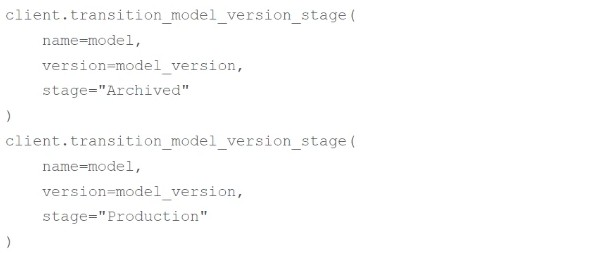
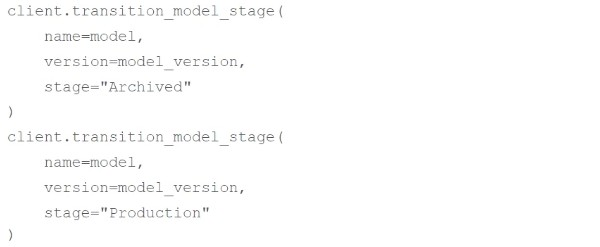
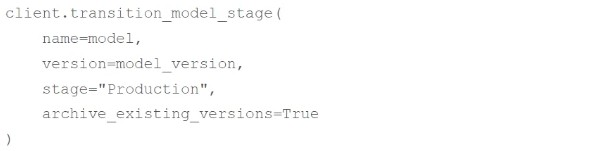
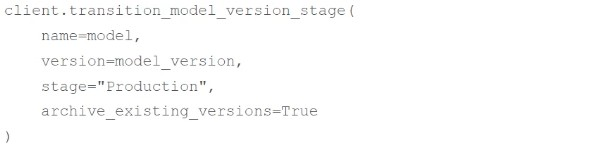
A machine learning engineer wants to move their model version model_version for the MLflow Model Registry model model from the Staging stage to the Production stage using MLflow Client client. At the same time, they would like to archive any model versions that are already in the Production stage.
Which of the following code blocks can they use to accomplish the task?
A)
B)
C)
D)
○
AOption A
○
BOption B
○
COption C
○
DOption D
DatabricksDatabricks Machine Learning Professional
Q2:
A machine learning engineer wants to log and deploy a model as an MLflow pyfunc model. They have custom preprocessing that needs to be completed on feature variables prior to fitting the model or computing predictions using that model. They decide to wrap this preprocessing in a custom model class ModelWithPreprocess, where the preprocessing is performed when calling fit and when calling predict. They then log the fitted model of the ModelWithPreprocess class as a pyfunc model.
Which of the following is a benefit of this approach when loading the logged pyfunc model for downstream deployment?
○
AThe pvfunc model can be used to deploy models in a parallelizable fashion
○
BThe same preprocessing logic will automatically be applied when calling fit
○
CThe same preprocessing logic will automatically be applied when calling predict
○
DThis approach has no impact when loading the logged Pvfunc model for downstream deployment
○
EThere is no longer a need for pipeline-like machine learning objects
DatabricksDatabricks Machine Learning Professional
Q3:
Which of the following MLflow Model Registry use cases requires the use of an HTTP Webhook?
○
AStarting a testing job when a new model is registered
○
BUpdating data in a source table for a Databricks SQL dashboard when a model version transitions to the Production stage
○
CSending an email alert when an automated testing Job fails
○
DNone of these use cases require the use of an HTTP Webhook
○
ESending a message to a Slack channel when a model version transitions stages
DatabricksDatabricks Machine Learning Professional
Q4:
Which of the following lists all of the model stages are available in the MLflow Model Registry?
○
ADevelopment. Staging. Production
○
BNone. Staging. Production
○
CStaging. Production. Archived
○
DNone. Staging. Production. Archived
○
EDevelopment. Staging. Production. Archived
DatabricksDatabricks Machine Learning Professional
Q5:
Which of the following is an advantage of using the python_function(pyfunc) model flavor over the built-in library-specific model flavors?
○
Apython_function provides no benefits over the built-in library-specific model flavors
○
Bpython_function can be used to deploy models in a parallelizable fashion
○
Cpython_function can be used to deploy models without worrying about which library was used to create the model
○
Dpython_function can be used to store models in an MLmodel file
○
Epython_function can be used to deploy models without worrying about whether they are deployed in batch, streaming, or real-time environments
🎉 Databricks Machine Learning Professional Quiz Complete!