Related Certification(s):
Fortinet Certified Professional, Fortinet FCP Fortinet Certified Professional Cloud Security Certifications
Fortinet NSE5_FWB_AD-8.0 Exam Topics - You’ll Be Tested in Actual Exam
Many candidates underestimate how much deployment decisions shape everything else on the Fortinet NSE 5 - FortiWeb 8.0 Administrator exam. Getting FortiWeb positioned correctly in a network isn't just a setup task. It determines how effectively every downstream security function performs. Candidates need to understand operation modes, network topology integration, and initial configuration steps before anything else makes sense. From that foundation, the exam moves into web application and API security, where the stakes get significantly higher. Protecting applications from injection attacks, cross-site scripting, and malicious bot traffic requires both policy configuration and an understanding of how FortiWeb detects and classifies threats. Botnet mitigation sits within this domain, and it demands attention because automated threats don't behave like human attackers. Knowing how to distinguish legitimate traffic from bot-driven abuse is a skill the exam tests directly. Application delivery ties these protections to real performance outcomes. Load balancing, content routing, and session persistence aren't isolated features. They work alongside security policies to keep applications both available and protected. The exam also covers compliance and troubleshooting, which many candidates treat as an afterthought. Compliance reporting connects FortiWeb's capabilities to regulatory requirements that organizations actually face. Troubleshooting skills, meanwhile, are what separate administrators who can configure a system from those who can maintain one under pressure. The NSE5_FWB_AD-8.0 exam tests this full range because organizations need administrators who can handle both the technical and operational sides of web application security long after the exam is passed.
Fortinet NSE5_FWB_AD-8.0 Exam Short Quiz
Attempt this Fortinet NSE5_FWB_AD-8.0 exam quiz to self-assess your preparation for the actual Fortinet NSE 5 - FortiWeb 8.0 Administrator exam. CertBoosters also provides premium Fortinet NSE5_FWB_AD-8.0 exam questions to pass the Fortinet NSE 5 - FortiWeb 8.0 Administrator exam in the shortest possible time. Be sure to try our free practice exam software for the Fortinet NSE5_FWB_AD-8.0 exam.
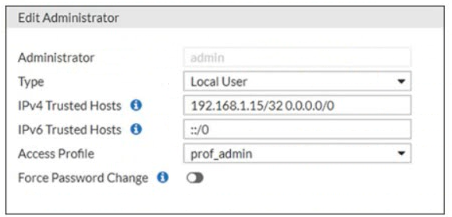
There is only one administrator account configured on FortiWeb and IPv6 is not configured on any interface.
Which action should an administrator take to restrict any brute force attacks that attempt to gain access to the FortiWeb management GUI?
○
AMake configuration changes on the upstream device.
○
BReplace 0.0.0.0/0 with a specific IP address.
○
CDelete the built-in administrator user and create a new one.
○
DChange the setting in the Access Profile field to Read_Only.
FortinetNSE5_FWB_AD-8.0
Q2:
A FortiWeb administrator sees the following request:
GET /api/v1/data HTTP/1.1
Host: example.com
Authorization: ApiKey abc123def456
The API key belongs to a user in group B who is authorized to access only /api/v1/reports.
What should the administrator do to prevent this unauthorized access?
○
ARestrict access to /api/v1/data using user group--based access control.
○
BBlock /api/v1/data for all user groups to avoid policy confusion.
○
CMove the user to group A so they can access both endpoints.
○
DAllow all valid API keys to access any API endpoint.
FortinetNSE5_FWB_AD-8.0
Q3:
You are a FortiWeb administrator investigating an SQL injection attack on your company's customer portal. The network firewall and intrusion prevention system (IPS) did not stop the attack.
You decide to deploy a web application firewall (WAF) to help prevent this type of attack.
Which two actions can you take to block application-layer threats? (Choose two.)
☐
AFocus on client-side risks, such as protecting user browsers.
☐
BInspect general network traffic equally between clients and servers.
☐
CDetect and block threats like SQL injection, cross-site scripting (XSS), and other Layer 7 attacks.
☐
DFilter and analyze HTTP/S requests to block attacks targeting the web server.
FortinetNSE5_FWB_AD-8.0
Q4:
You are reviewing SSL-related issues on FortiWeb. An administrator reports that they receive a certificate warning when they access the FortiWeb GUI over HTTPS. Separately, your FortiWeb device also makes outbound HTTPS requests to a back-end API server.
In which two situations would FortiWeb use its own certificates to establish or secure the connection? (Choose two.)
☐
AWhen a client browser initiates an SSL session and FortiWeb is in transparent inspection mode.
☐
BWhen FortiWeb is routing an HTTPS connection to a FortiGate without decrypting it.
☐
CWhen an administrator connects to the FortiWeb GUI using HTTPS in a browser.
☐
DWhen FortiWeb connects to a back-end server over HTTPS as a client.
FortinetNSE5_FWB_AD-8.0
Q5:
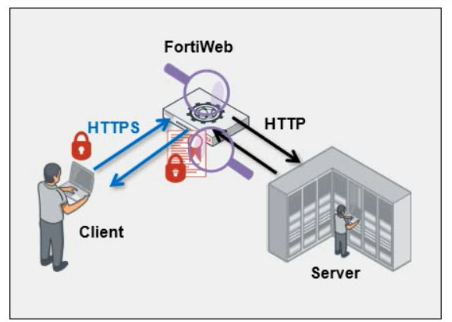
Refer to the exhibit.
You are configuring SSL offloading on FortiWeb to protect a public-facing application. Clients connect using HTTPS, while FortiWeb forwards requests to the back-end server using HTTP.
You are reviewing certificate deployment and need to decide where to install the private key for the certificate used in client connections.
In this SSL offloading setup, which device is responsible for using the private key associated with the web server certificate?
○
AFortiWeb, because it terminates the HTTPS session and decrypts traffic.
○
BNone. SSL offloading does not require a private key because FortiWeb only forwards traffic.
○
CThe server, because it always handles certificates regardless of SSL mode.
○
DThe client, because it initiates the TLS handshake and verifies the certificate.