Related Certification(s):
Fortinet , Fortinet Certifications
Fortinet NSE7_SSE_AD-25 Exam Topics - You’ll Be Tested in Actual Exam
For the Fortinet NSE 7 FortiSASE 25 Enterprise Administrator exam, you should understand how SASE architecture and integration combines security and connectivity as a cloud delivered service, and how FortiSASE fits with Fortinet components such as FortiGate, FortiClient, identity providers, and existing networking to protect users no matter where they work. You also need practical knowledge of SASE deployment and management, including onboarding users and sites, choosing deployment models, applying security profiles and access policies, managing certificates and authentication, and using centralized workflows to keep configuration consistent while troubleshooting common connectivity and policy issues. A key focus is Secure Private Access (SPA), which provides zero trust style access to private applications by verifying user identity, device posture, and policy before granting least privilege access, while reducing exposure compared to traditional VPN by limiting lateral movement and improving segmentation. Finally, Analytics covers how FortiSASE collects logs and telemetry to provide visibility into user activity, application usage, threats, and policy effectiveness, and how to interpret dashboards, generate reports, investigate incidents, and tune policies based on trends and alerts to improve security posture and user experience.
Fortinet NSE7_SSE_AD-25 Exam Short Quiz
Attempt this Fortinet NSE7_SSE_AD-25 exam quiz to self-assess your preparation for the actual Fortinet NSE 7 - FortiSASE 25 Enterprise Administrator exam. CertBoosters also provides premium Fortinet NSE7_SSE_AD-25 exam questions to pass the Fortinet NSE 7 - FortiSASE 25 Enterprise Administrator exam in the shortest possible time. Be sure to try our free practice exam software for the Fortinet NSE7_SSE_AD-25 exam.
An organization needs to resolve internal hostnames using its internal rather than public DNS servers for remotely connected endpoints. Which two components must be configured on FortiSASE to achieve this? (Choose two.)
☐
ASSL deep inspection
☐
BSplit DNS rules
☐
CSplit tunnelling destinations
☐
DDNS filter
FortinetNSE7_SSE_AD-25
Q2:
When viewing the daily summary report generated by FortiSASE. the administrator notices that the report contains very little dat
a. What is a possible explanation for this almost empty report?
○
ADigital experience monitoring is not configured.
○
BLog allowed traffic is set to Security Events for all policies.
○
CThe web filter security profile is not set to Monitor
○
DThere are no security profile group applied to all policies.
FortinetNSE7_SSE_AD-25
Q3:
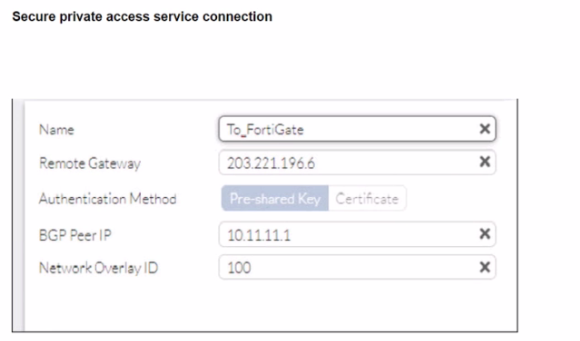
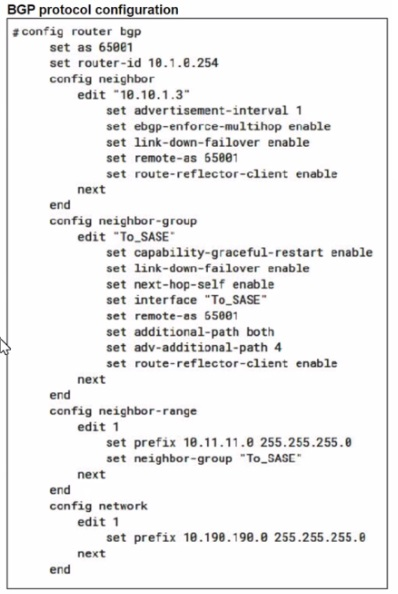
Refer to the exhibits.
A FortiSASE administrator is trying to configure FortiSASE as a spoke to a FortiGate hub. The VPN tunnel does not establish
Based on the provided configuration, what configuration needs to be modified to bring the tunnel up?
○
ANAT needs to be enabled in the Spoke-to-Hub firewall policy.
○
BThe BGP router ID needs to match on the hub and FortiSASE.
○
CFortiSASE spoke devices do not support mode config.
○
DThe hub needs IKEv2 enabled in the IPsec phase 1 settings.
FortinetNSE7_SSE_AD-25
Q4:
You are designing a new network, and the cybersecurity policy mandates that all remote users working from home must always be connected and protected. Which FortiSASE component facilitates this always-on security measure? (Choose one answer)
○
AUnified FortiClient
○
BSDWAN on-ramp2
○
CSecure web gateway
○
DThin-branch SASE extension
FortinetNSE7_SSE_AD-25
Q5:
Which two statements about FortiSASE Geofencing with regional compliance are true? (Choose two answers)
☐
AYou can configure regional compliance on the security POP or the on-premises device, not both.1
☐
BIf no regional compliance rule is configured, the connection is made to the closest security POP.
☐
CA regional compliance rule can connect only to an on-premises device or only to a security POP.2
☐
DThe connection order for a regional compliance rule is always the security POP first, followed by the on-premises device.