Available Number of Questions: Maximum of
60 Questions
Exam Name: Aruba Certified Network Security Expert Written Exam
Exam Duration: 120 Minutes
Related Certification(s):
HP Aruba Certification
HP HPE6-A84 Exam Topics - You’ll Be Tested in Actual Exam
You will spend most of your mental energy on protect and defend, and not in the shallow way people expect. The exam keeps pushing you past naming features into choosing defenses that hold up when traffic patterns, user access, and policy intent collide. It wants you to think like someone who has to keep an environment safe all day, not just pass a lab once. You need to read a situation, decide what should be allowed, and then spot what would quietly break security if you trusted defaults or copied a familiar template. Analyze shows up as the bridge between your controls and real behavior, because you are expected to interpret what the network is telling you and decide whether it matches your intended protections. Investigate is where the pressure rises. You are not chasing trivia, you are tracing cause and effect, using clues from what you observed to narrow down what happened and what to do next. Candidates get tripped up when they treat these as separate tasks, because the exam keeps mixing them inside one scenario and punishes answers that ignore downstream impact. Study with a habit of explaining your own reasoning out loud, since the fastest way to improve is to notice when your defensive choice would create ambiguous signals during analysis and make investigation harder later.
HP HPE6-A84 Exam Short Quiz
Attempt this HP HPE6-A84 exam quiz to self-assess your preparation for the actual HP Aruba Certified Network Security Expert Written Exam . CertBoosters also provides premium HP HPE6-A84 exam questions to pass the HP Aruba Certified Network Security Expert Written Exam in the shortest possible time. Be sure to try our free practice exam software for the HP HPE6-A84 exam.
1of 0 questions |
HP HPE6-A84 Exam Quiz
✓ 0 answered
🔖 0 bookmarked
HPHPE6-A84
Q1:
Refer to the exhibit.
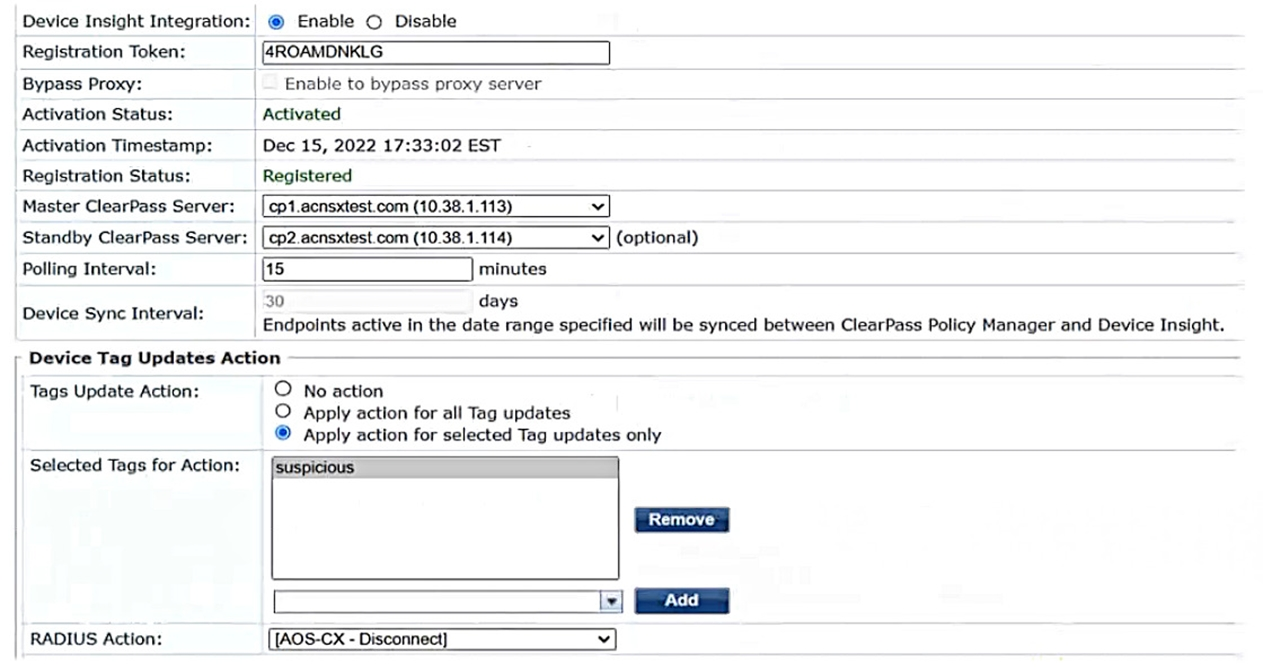
Aruba ClearPass Policy Manager (CPPM) is using the settings shown in the exhibit. You reference the tag shown in the exhibit in enforcement policies related to NASes of several types, including Aruba APs, Aruba gateways, and AOS-CX switches.
What should you do to ensure that clients are reclassified and receive the correct treatment based on the tag?
○
AChange the RADIUS action to [Aruba Wireless -Terminate Session] which is supported by all the NASes in question.
○
BChange the RADIUS action to [Aruba Wireless - Bounce Switch Port] which is supported by all the NASes in question.
○
CEnable profiling in each service using one of these enforcement profiles. Set the profiling action to the correct one for the NASes using that service.
○
DSet the Tags Update Action to No Action. Then instead enable the RADIUS CoAs using enforcement profiles in the rules that match clients with the tag shown in the exhibit.
HPHPE6-A84
Q2:
Refer to the scenario.
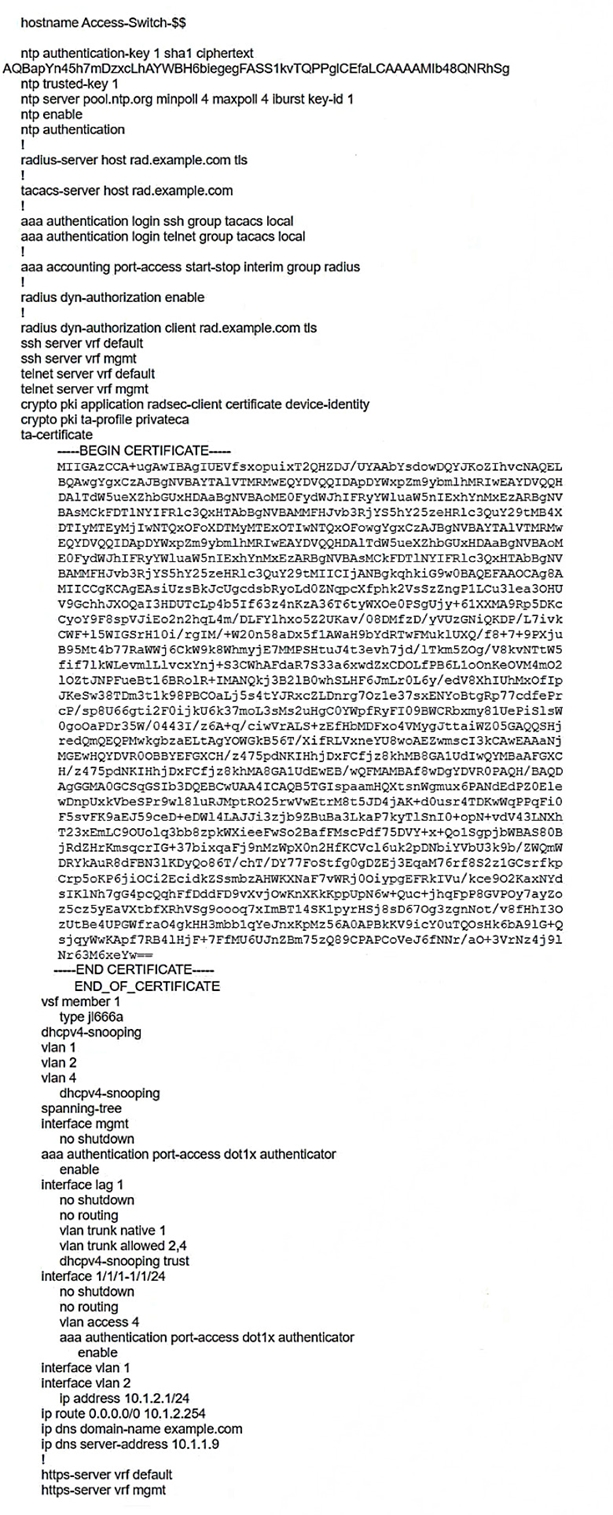
A customer has asked you to review their AOS-CX switches for potential vulnerabilities. The configuration for these switches is shown below:
What is one immediate remediation that you should recommend?
○
AChanging the switch's DNS server to the mgmt VRF
○
BSetting the clock manually instead of using NTP
○
CEither disabling DHCPv4-snoopinq or leaving it enabled, but also enabling ARP inspection
○
DDisabling Telnet
HPHPE6-A84
Q3:
Refer to the scenario.
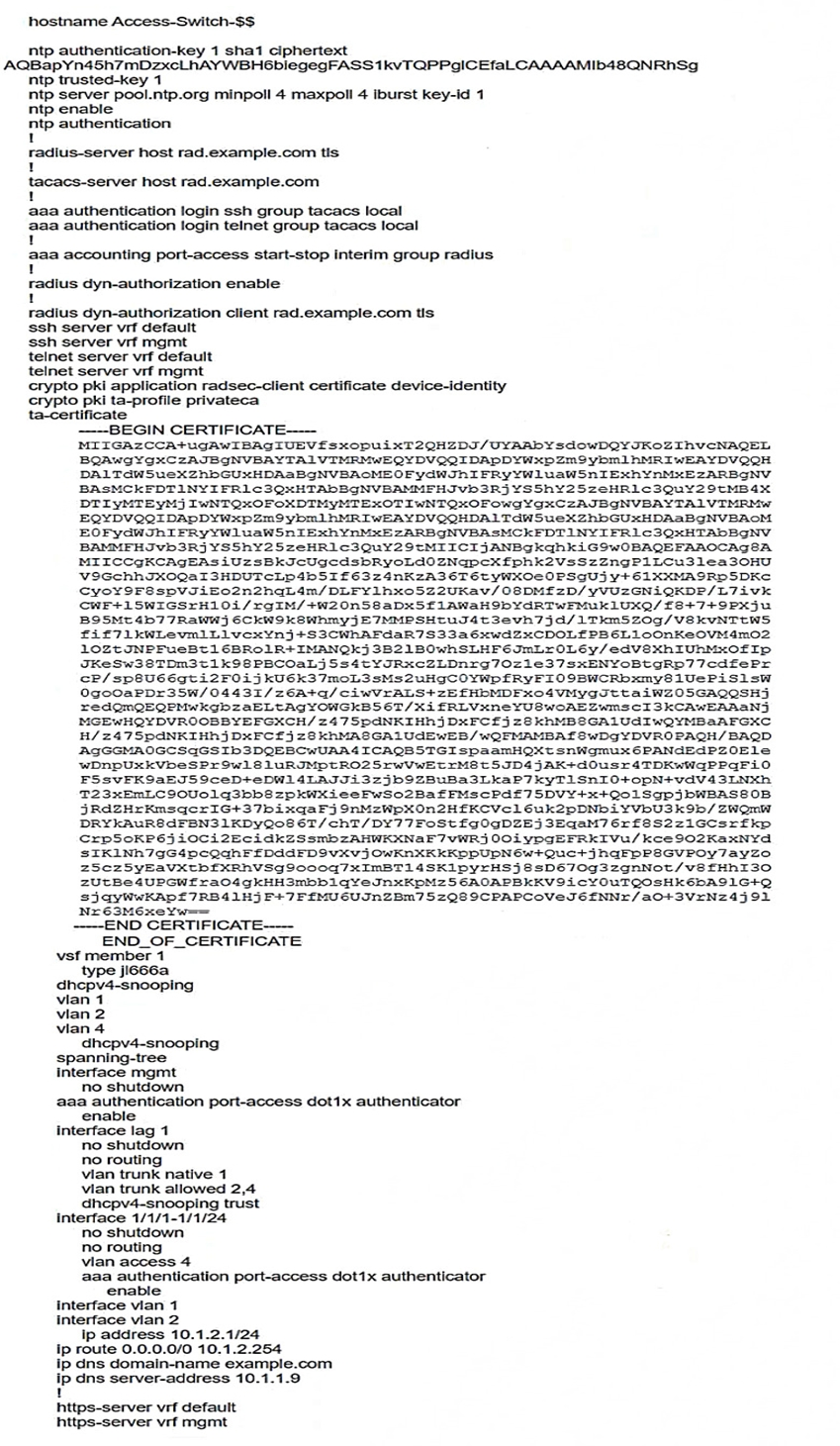
A customer has asked you to review their AOS-CX switches for potential vulnerabilities. The configuration for these switches is shown below:
What is one recommendation to make?
○
ALet the RADIUS server confiqure VLANs on LAG 1 dynamically.
○
BUse MDS instead of SHA1 for the NTP authentication key.
○
CEncrypt the certificate in the TA-profile.
○
DCreate a control plane ACL to limit the sources that can access the switch with SSH.
HPHPE6-A84
Q4:
You want to use Device Insight tags as conditions within CPPM role mapping or enforcement policy rules.
What guidelines should you follow?
○
ACreate an HTTP authentication source to the Central API that queries for the tags. To use that source as the type for rule conditions, add it an authorization source for the service in question.
○
BUse the Application type for the rule conditions; no extra authorization source is required for services that use policies with these rules.
○
CUse the Endpoints Repository type for the rule conditions; Add Endpoints Repository as a secondary authentication source for services that use policies with these rules.
○
DUse the Endpoint type for the rule conditions; no extra authorization source is required for services that use policies with these rules.
HPHPE6-A84
Q5:
You are working with a developer to design a custom NAE script for a customer. The NAE agent should trigger an alert when ARP inspection drops packets on a VLAN. The customer wants the admins to be able to select the correct VLAN ID for the agent to monitor when they create the agent.
What should you tell the developer to do?
○
AUse this variable, %{vlan-id} when defining the monitor URI in the NAE agent script.
○
BDefine a VLAN ID parameter; reference that parameter when defining the monitor URI.
○
CCreate multiple monitors within the script from which admins can select when they create the agent.
○
DUse a callback action to collect the ID of the VLAN on which admins have enabled NAE monitoring.