
Juniper
JN0-351
Q1:
After receiving a BGP route, which two conditions are verified by the receiving router to ensure that the received route is valid? (Choose two)
☐
A
The AS-path length is greater than 0.☐
B
The loops do not exist.☐
C
The next hop is reachable.☐
D
The local preference is greater than 0.
Juniper
JN0-351
Q2:
You want to ensure traffic is routed through a GRE tunnel.
In this scenario, which two statements will satisfy this requirement? (Choose two.)
☐
A
Tunnel endpoints must have a route that directs traffic into the tunnel.☐
B
All intermediary devices must have a route to the tunnel endpoints.☐
C
Keepalives must be used on stateless tunneling protocols.☐
D
BFD must be used on the stateless tunneling protocols.
Juniper
JN0-351
Q3:
You want to use filter-based forwarding (FBF) on your Internet peering router to load-balance traffic to two directly connected ISPs based on the source address.
Which two statements are correct in this scenario? (Choose two.)
☐
A
FBF uses the no-forwarding routing instance type.☐
B
FBF uses the forwarding routing instance type.☐
C
RIB groups are used to copy routes from the inet. o routing table.☐
D
RIB groups are used to hide routes in the inet. 0 routing table.
Juniper
JN0-351
Q4:
Which two statements are correct about generated routes? (Choose two.)
☐
A
Generated routes require a contributing route.☐
B
Generated routes show a next hop in the routing table.☐
C
Generated routes appear in the routing table as static routes☐
D
Generated routes cannot be redistributed into dynamic routing protocols.
Juniper
JN0-351
Q5:
Exhibit.
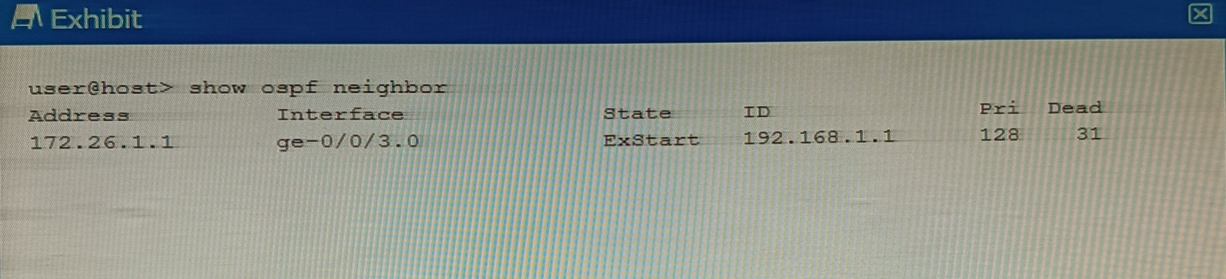
Why is this OSPF adjacency remaining in this state?
○
A
A subnet mask mismatch exists between the OSPF neighbors.○
B
An MTU mismatch exists between the OSPF neighbors.○
C
A hello interval mismatch exists between the OSPF neighbors.○
D
An area ID mismatch exists between the OSPF neighbors