Available Number of Questions: Maximum of
72 Questions
Exam Name: Enterprise Routing and Switching, Professional
Related Certification(s):
Juniper Enterprise Routing and Switching Certification
Juniper JN0-650 Exam Topics - You’ll Be Tested in Actual Exam
The Juniper JN0-650 exam assesses your knowledge and skills in network design, implementation, and troubleshooting. It covers a range of topics crucial for network professionals, ensuring a solid understanding of network fundamentals, IP addressing, routing protocols, and network security. You'll delve into network infrastructure, learning about routers, switches, and their configuration. The exam also emphasizes network services, such as DHCP, DNS, and firewall configurations, ensuring a comprehensive grasp of network operations. Additionally, it explores network management and monitoring, teaching you how to effectively oversee and maintain network performance. Advanced routing concepts, including OSPF, BGP, and policy-based routing, are also key areas of focus. Lastly, the exam tests your knowledge of network troubleshooting techniques, enabling you to identify and resolve common network issues. With a comprehensive approach, the JN0-650 exam equips you with the expertise needed to design, implement, and manage robust and secure network environments.
Juniper JN0-650 Exam Short Quiz
Attempt this Juniper JN0-650 exam quiz to self-assess your preparation for the actual Juniper Enterprise Routing and Switching, Professional exam. CertBoosters also provides premium Juniper JN0-650 exam questions to pass the Juniper Enterprise Routing and Switching, Professional exam in the shortest possible time. Be sure to try our free practice exam software for the Juniper JN0-650 exam.
1of 0 questions |
Juniper JN0-650 Exam Quiz
✓ 0 answered
🔖 0 bookmarked
JuniperJN0-650
Q1:
Which two EVPN types advertise an ESI without advertising a MAC address? (Choose two.)
☐
AType1
☐
BType 2
☐
CType 3
☐
DType 4
JuniperJN0-650
Q2:
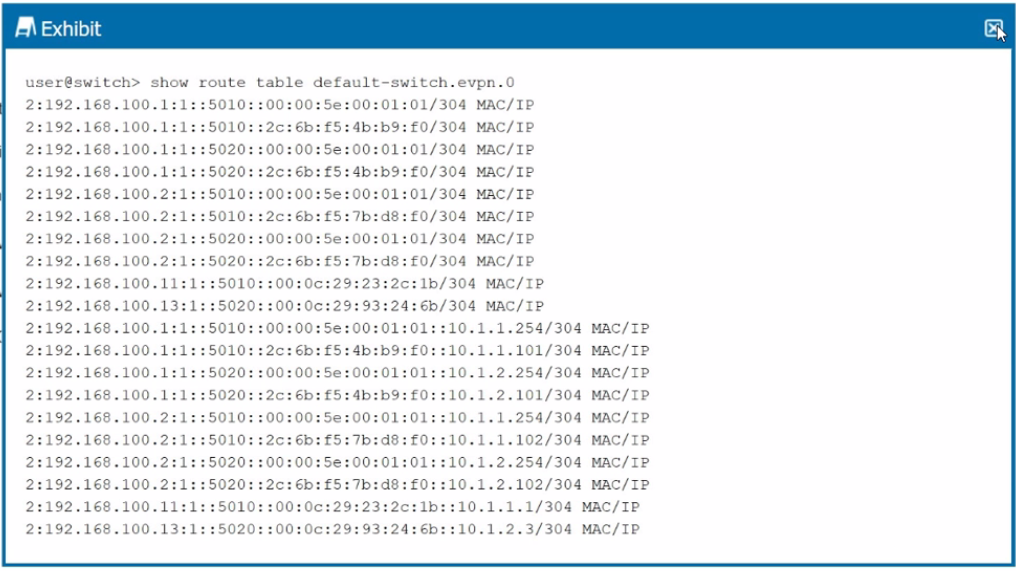
Exhibit
Referring to the exhibit output, which statement is correct?
○
AThe device with an IP address of 192.168.100 2 is attached to VNI 5010
○
BThe output shows the router ID of the device sending the EVPN Type 2 routes
○
CThe output shows the route distinguisher of the device sending the EVPN Type 2 routes
○
DIP addresses 10.1.1.1 and 10.1 2.3 are connected to the same VNI.
JuniperJN0-650
Q3:
Your OSPF network consists of a mix of 1GbE and 10GbE interfaces. By default, all interfaces have the same cost in your OSPF network. You are asked to ensure that the 10GbE interfaces are more preferred when available
In this scenario, which two statements would accomplish this behavior? (Choose two.)
☐
AYou should define the reference bandwidth as 10G. which will assign the 1GbE interfaces a higher cost
☐
BYou should manually assign the interface metric for each 10GbE interface to be higher than the 1GbE interfaces in your OSPF network.
☐
CYou should define the reference bandwidth as 1G. which will assign the 1GbE interfaces a higher cost.
☐
DYou should manually assign the interface metric for each 1GbE interface to be higher than the 10GbE interfaces in your OSPF network.
JuniperJN0-650
Q4:
Which two statements are correct about EVPN Pure Type-5 routes? (Choose two.)
☐
APure Type-5 routes rely on Type-7 sync routes
☐
BPure Type-5 routes require an overlay next hop.
☐
CPure Type-5 routes are also known as IP-VRF-to-IP-VRF.
☐
DPure Type-5 routes are advertised with the MAC extended community.
JuniperJN0-650
Q5:
You configured MVRP in your Layer 2 network and you are adding two new interfaces to your distribution switch. You are asked to ensure that if a rogue device that uses MVRP is connected to these interfaces, that the MVRP PDUs are ignored
In this scenario, what should you configure to accomplish this task?
○
AConfigure the join-timer to 500 ms.
○
BConfigure the no-dynamic-vlan feature under MVRP.
○
CConfigure the two new interfaces as point-to-point.
○
DConfigure the two new interfaces under MVRP using the forbidden registration mode.