Related Certification(s):
Netskope Cloud Security Certification Program Certification
Netskope NSK101 Exam Topics - You’ll Be Tested in Actual Exam
The Netskope NSK101 exam is an essential certification for anyone looking to establish a strong foundation in cloud security. This exam covers a wide range of topics, including cloud access security broker (CASB) fundamentals, which provide an overview of the cloud security landscape and the role of CASBs in securing cloud environments. You'll learn about the various deployment models, such as public, private, and hybrid clouds, and understand the unique security challenges posed by each. Additionally, the exam delves into cloud security policies, teaching you how to create and enforce policies to protect sensitive data and ensure compliance with regulatory standards. Data loss prevention (DLP) is another critical aspect covered, focusing on identifying and preventing data breaches and unauthorized data exfiltration. The exam also equips you with the skills to detect and respond to threats, such as malware and phishing attacks, through effective threat protection strategies. Moreover, you'll explore the concept of zero-trust access, a security model that verifies every user and device before granting access to resources. This includes understanding the principles of least privilege and just-in-time access, ensuring that only authorized users can access the necessary resources at the right time. Another key area is cloud application security, where you'll learn to assess the security posture of cloud applications and implement measures to mitigate risks. This includes techniques for identifying and managing shadow IT, where unauthorized cloud applications are used within an organization. Additionally, the exam covers cloud infrastructure security, teaching you how to secure virtual machines, containers, and other cloud-based resources. You'll also gain insights into cloud-native security, which involves understanding the unique security considerations and best practices for cloud-native applications and services. Lastly, the Netskope NSK101 exam emphasizes the importance of user education and awareness, as human error is often a significant factor in security breaches. By understanding these topics and passing the exam, you'll be well-equipped to navigate the complex world of cloud security and protect your organization's valuable assets.
Netskope NSK101 Exam Short Quiz
Attempt this Netskope NSK101 exam quiz to self-assess your preparation for the actual Netskope Certified Cloud Security Administrator Exam . CertBoosters also provides premium Netskope NSK101 exam questions to pass the Netskope Certified Cloud Security Administrator Exam in the shortest possible time. Be sure to try our free practice exam software for the Netskope NSK101 exam.
1of 0 questions |
Netskope NSK101 Exam Quiz
✓ 0 answered
🔖 0 bookmarked
NetskopeNSK101
Q1:
As an administrator, you are investigating an increase in the number of incidents related to compromised credentials. You are using the Netskope Compromised Credentials feature on your tenant to assess the situation. Which insights would you find when using this feature? (Choose two)
☐
ACompromised usernames
☐
BBreach information source
☐
CCompromised passwords
☐
DAffected managed applications
NetskopeNSK101
Q2:
Your customer asks you to secure all Web traffic as part of the initial configuration. In the Netskope platform, which statement is correct in this scenario?
○
AAdd the all Web traffic option to the steering configuration.
○
BNetskope automatically steers all Web traffic.
○
CNetskope cannot steer Web traffic.
○
DSelect all Web traffic in the SSL decryption section.
NetskopeNSK101
Q3:
You are asked to review files affected by malware in your organization. In this scenario, which two actions are possible and would be accessible from the Netskope UI -> Incidents --> Malware? (Choose two)
☐
ADownload the original malware file generating the alert to be analyzed by the SOC team
☐
BIdentify the exposure of the file identified as malware.
☐
CRemediate the compromised devices.
☐
DDetermine the Detection Engine used to identify the malware.
NetskopeNSK101
Q4:
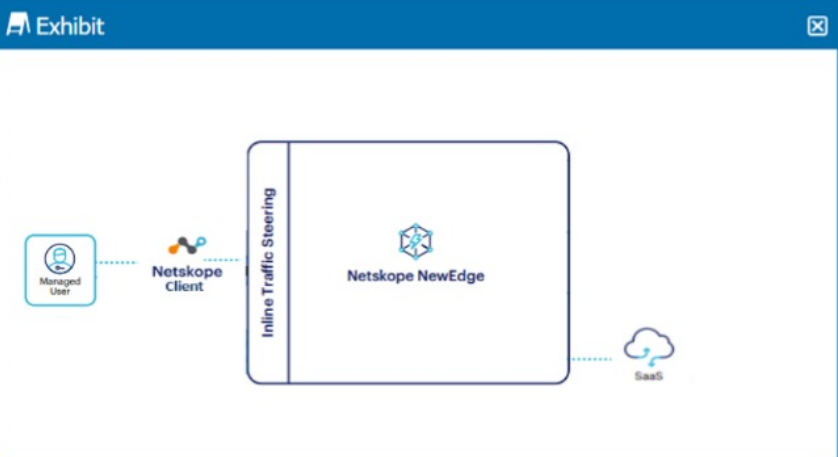
Click the Exhibit button.
A user is connected to a SaaS application through Netskope's Next Gen SWG with SSL inspection enabled. In this scenario, what information is available in SkopeIT? (Choose three.)
☐
AUser activity, CCL
☐
BDestination IP, OS patch version
☐
CAccount instance, category
☐
DUsername, source location
☐
EFile version, shared folder
NetskopeNSK101
Q5:
Your customer has cloud storage repositories containing sensitive files of their partners, including bank statements, consulting, and disclosure agreements. In this scenario, which feature would help them control the flow of these types of documents?