Related Certification(s):
Netskope Cloud Security Certification Program Certification
Netskope NSK200 Exam Topics - You’ll Be Tested in Actual Exam
The Netskope NSK200 exam is a comprehensive assessment that evaluates your understanding of cloud security and data protection. It covers a wide range of topics, including cloud access security broker (CASB) architecture, which involves understanding the components and layers of a CASB solution and how they work together to secure cloud environments. You'll also delve into cloud security posture management (CSPM), learning about the tools and techniques used to assess and improve the security posture of cloud environments. Another crucial aspect is cloud security analytics, where you'll explore methods to analyze and interpret data for threat detection and response. Additionally, the exam tests your knowledge of cloud access management, focusing on identity and access management (IAM) strategies and policies to control user access to cloud resources. Zero trust architecture is another key topic, emphasizing the principles of verifying every user and device before granting access. The exam also covers cloud data loss prevention (DLP), teaching you how to identify and protect sensitive data in the cloud. Furthermore, you'll study cloud forensics and incident response, learning to investigate and respond to security incidents in cloud environments. Finally, the exam assesses your understanding of cloud security operations, including the tools and processes used to monitor and manage cloud security. These topics provide a solid foundation for securing cloud environments and protecting sensitive data, making the NSK200 exam an essential step for professionals in the field of cloud security.
Netskope NSK200 Exam Short Quiz
Attempt this Netskope NSK200 exam quiz to self-assess your preparation for the actual Netskope Certified Cloud Security Integrator exam. CertBoosters also provides premium Netskope NSK200 exam questions to pass the Netskope Certified Cloud Security Integrator exam in the shortest possible time. Be sure to try our free practice exam software for the Netskope NSK200 exam.
1of 0 questions |
Netskope NSK200 Exam Quiz
✓ 0 answered
🔖 0 bookmarked
NetskopeNSK200
Q1:
Your company asks you to use Netskope to integrate with Endpoint Detection and Response (EDR) vendors such as Crowdstrike.
Which two requirements are needed for a successful integration and sharing of threat data? (Choose two.)
☐
ARemediation profile
☐
BDevice classification
☐
CAPI Client ID
☐
DCustom log parser
NetskopeNSK200
Q2:
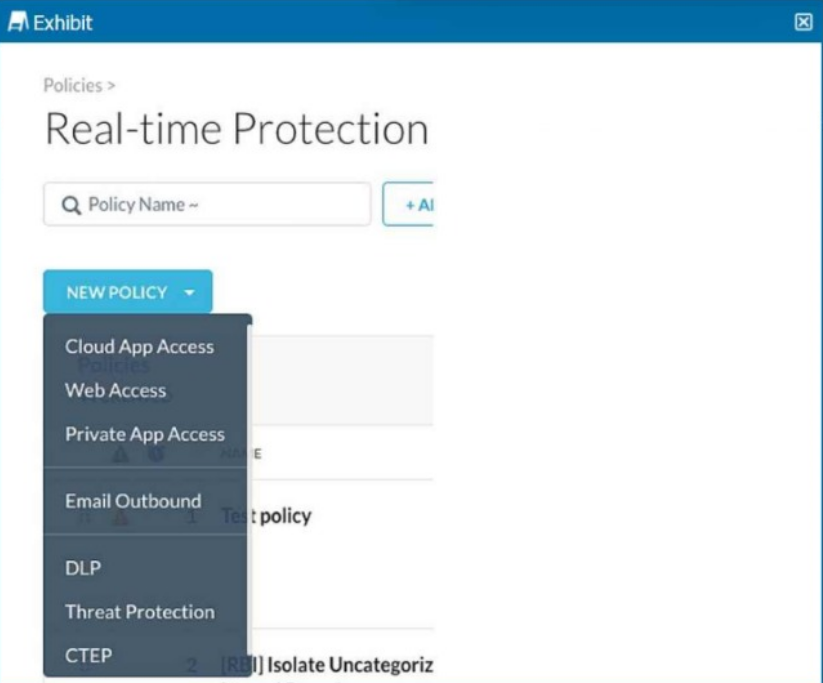
Review the exhibit.
You are asked to create a new Real-time Protection policy to scan SMTP emails using data loss prevention (DLP) for personal health information (PHI). The scope is limited to only emails being sent from Microsoft Exchange Online to outside recipients.
○
AWeb Access policy
○
BEmail Outbound policy
○
CCTEP policy
○
DDLP policy
NetskopeNSK200
Q3:
You are deploying a Netskope client in your corporate office network. You are aware of firewall or proxy rules that need to be modified to allow traffic.
Which two statements are true in this scenario? (Choose two.)
☐
AYou need to allow TLS 1.1 traffic to pass through the firewalls from the users' IP to all destinations.
☐
BYou must enable SSL decryption in the proxy to inspect the Netskope tunnel.
☐
CIt is recommended to allow UDP port 443 to the Netskope IP ranges to allow DTLS.
☐
DYou need to allow TCP port 443 to the Netskope IP ranges or domains.
NetskopeNSK200
Q4:
Your company is using on-premises QRadar as a SIEM solution. They are replacing it with Rapid7 in the cloud. The legacy on-premises QRadar will eventually be decommissioned. Your IT department does not want to use the same token that QRadar uses.
○
ANetskope does not support multiple REST API tokens.
○
BYou must use Netskope REST API v1 to support multiple tokens to share events.
○
CYou must use Netskope REST API v2 to support multiple tokens to share events.
○
DYou must use an Advanced Threat Protection license to support multiple tokens to share events.
NetskopeNSK200
Q5:
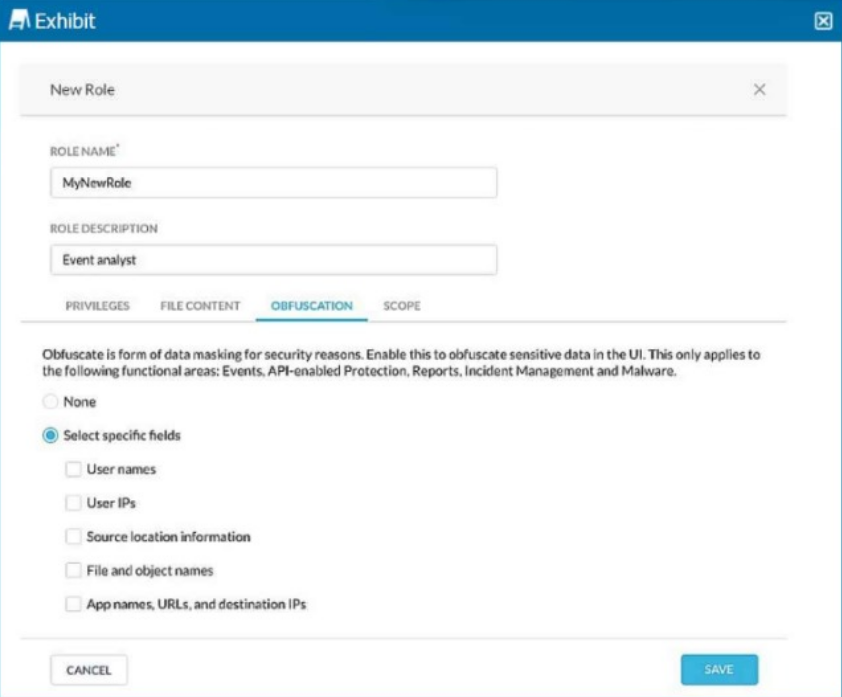
Review the exhibit.
You are asked to create a new role that allows analysts to view Events and Reports while providing user privacy. You need to avoid directly exposing identities and user location information.
Which three fields must you obfuscate in this scenario? (Choose three.)