Available Number of Questions: Maximum of
40 Questions
Exam Name: Nokia IS-IS Routing Protocol
Exam Duration: 90 Minutes
Related Certification(s):
Nokia Network Routing Specialist II Certification
Nokia 4A0-112 Exam Topics - You’ll Be Tested in Actual Exam
The Nokia 4A0-112 exam covers a wide range of topics essential for network professionals, ensuring a comprehensive understanding of network fundamentals, advanced routing, and switching. It delves into the core principles of networking, exploring network architecture, protocols, and the critical role of IP addressing. Candidates will gain expertise in designing, implementing, and troubleshooting various network topologies, including LANs, WANs, and VPNs. The exam also emphasizes the importance of network security, covering topics such as authentication, access control, and encryption. Additionally, it provides an in-depth understanding of routing protocols like OSPF and BGP, enabling effective route optimization and network management. Switching technologies, including VLANs and trunking, are also extensively covered, ensuring candidates can efficiently manage and optimize network traffic. Furthermore, the exam explores quality of service (QoS) mechanisms, allowing professionals to prioritize network traffic and ensure optimal performance. By mastering these topics, candidates will be well-equipped to design, deploy, and maintain robust and secure network infrastructures, positioning themselves as valuable assets in the field of networking.
Nokia 4A0-112 Exam Short Quiz
Attempt this Nokia 4A0-112 exam quiz to self-assess your preparation for the actual Nokia IS-IS Routing Protocol exam. CertBoosters also provides premium Nokia 4A0-112 exam questions to pass the Nokia IS-IS Routing Protocol exam in the shortest possible time. Be sure to try our free practice exam software for the Nokia 4A0-112 exam.
1of 0 questions |
Nokia 4A0-112 Exam Quiz
✓ 0 answered
🔖 0 bookmarked
Nokia4A0-112
Q1:
When multiple routing protocols offer a route for the same prefix, what part of the router is in charge of deciding which route to make active?
○
AThe routing information base (RIB)
○
BThe routing table manager (RTM)
○
CThe equal cost multipath configuration
○
DThe forwarding information base (FIB)
Nokia4A0-112
Q2:
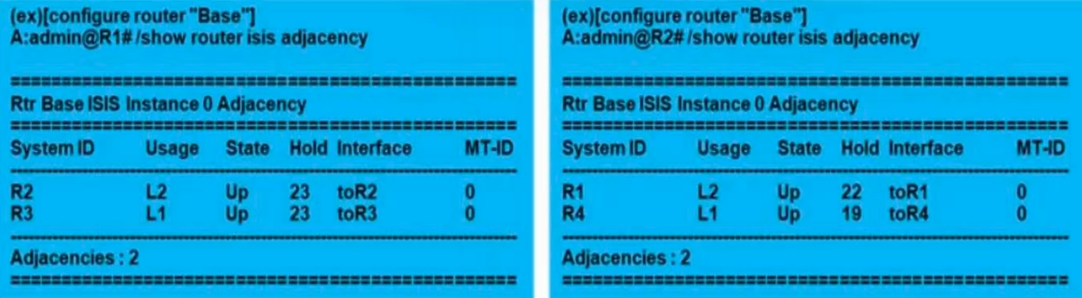
Refer to the exhibit.
Routers R1, R2, R3, and R4 are running IS-IS. Assuming all interfaces are added to IS-IS as point-to-point and no commands are issued at the interface level to restrict adjacencies, which of the following statements is TRUE?
○
ARouters R1 and R2 are L2 routers. Routers R3 and R4 are L1 routers.
○
BRouters R1 and R2 are L2 routers. Routers R3 and R4 are L1/L2 routers.
○
CRouters R1 and R2 are L1/L2 routers. Routers R3 and R4 are L1 routers.
○
DAll four routers are L1/L2.
Nokia4A0-112
Q3:
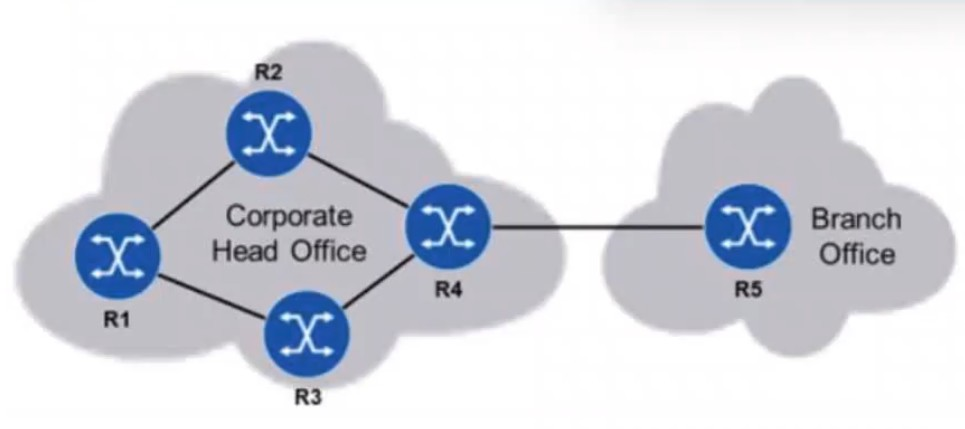
Refer to the exhibit.
Static routing is to be used in a network between a corporate head office and a branch office. The head office has many connected subnetworks, whereas the branch office has one subnetwork and a single connection to the head office. Which of the following is the most likely configuration on the head office and branch office routers?
○
AThe head office has a default route and the branch office has a specific static route.
○
BThe head office and the branch offices both have specific static routes.
○
CThe head office and the branch office both have default routes.
○
DThe head office has a specific static route and the branch office has a default route.
Nokia4A0-112
Q4:
A router is trying to establish an IS-IS adjacency with the DIS on a broadcast link. What event causes the adjacency to change from ''Initializing'' to ''UP''?
○
AReceiving a Hello packet from the DIS that contains the local router's own MAC address in the neighbor list.
○
BReceiving the first CSNP packet from the DIS that lists the LSPs in the DIS's link-state database.
○
CReceiving a CSNP packet from the DIS acknowledging the last transmitted LSP.
○
DReceiving the last LSP requested from the DIS.
Nokia4A0-112
Q5:
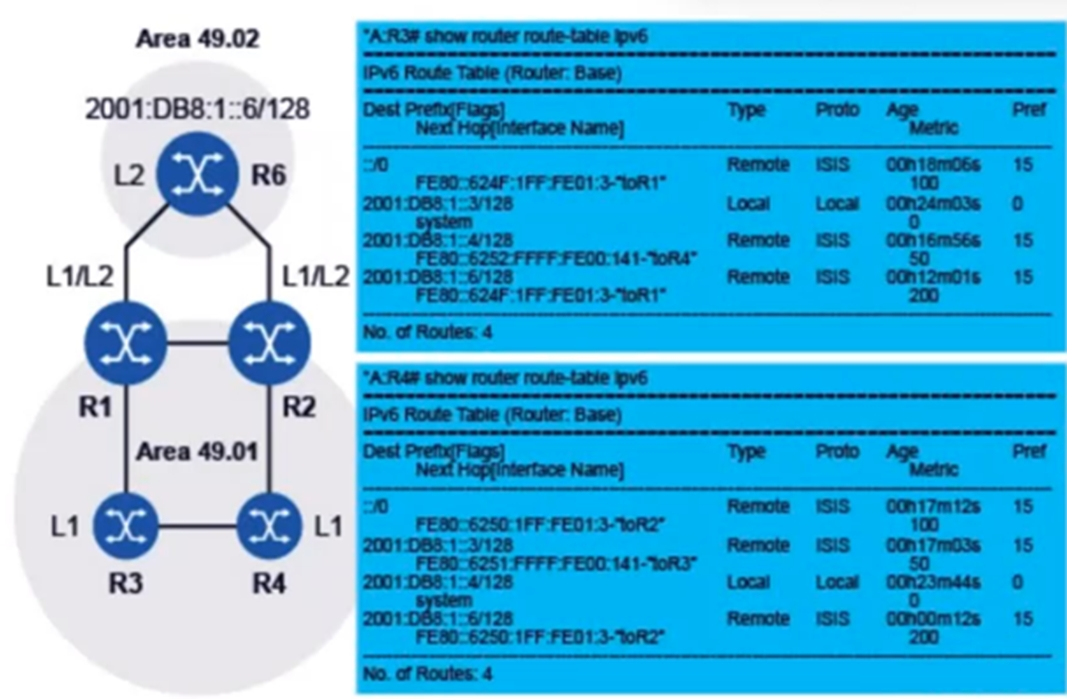
Consider the exhibit.
All routers are running IS-IS with IPv6 support enabled. Based on the topology shown, and the route tables of routers R3 and R4, which of the following statements is TRUE?
○
AThere is no route leaking configured on router R1 or router R2.
○
BRoute leaking is configured on router R1 but not on router R2.
○
CRoute leaking is configured on router R2 but not on router R1.
○
DRoute leaking is configured on both routers R1 and R2.