Available Number of Questions: Maximum of
100 Questions
Exam Name: Nutanix Certified Professional - End User Computing v6.10
Exam Duration: 120 Minutes
Related Certification(s):
Nutanix Certified Professional Certification
Nutanix NCP-EUC Exam Topics - You’ll Be Tested in Actual Exam
The Nutanix NCP-EUC exam is a comprehensive assessment designed to evaluate your understanding of Nutanix's Enterprise Cloud platform and its capabilities. It covers a wide range of topics, including the core concepts and architecture of Nutanix, such as its distributed storage fabric, web-scale design, and hyper-converged infrastructure. You'll delve into the management and operations of Nutanix environments, learning about Prism Element and Prism Central, which are powerful tools for monitoring, managing, and automating your infrastructure. The exam also emphasizes the importance of security and compliance, ensuring you grasp the principles of securing your Nutanix environment, including data protection, encryption, and access control. Additionally, you'll explore networking and connectivity, understanding how Nutanix integrates with various network topologies and protocols. Another key area is disaster recovery and business continuity, where you'll learn strategies for protecting your data and ensuring business resilience. The exam also covers application mobility and containerization, showcasing how Nutanix enables the seamless migration and management of applications. Lastly, you'll gain insights into the economics and business value of Nutanix, understanding how it can drive cost efficiency and improve operational flexibility.
Nutanix NCP-EUC Exam Short Quiz
Attempt this Nutanix NCP-EUC exam quiz to self-assess your preparation for the actual Nutanix Certified Professional - End User Computing v6.10 exam. CertBoosters also provides premium Nutanix NCP-EUC exam questions to pass the Nutanix Certified Professional - End User Computing v6.10 exam in the shortest possible time. Be sure to try our free practice exam software for the Nutanix NCP-EUC exam.
1of 0 questions |
Nutanix NCP-EUC Exam Quiz
✓ 0 answered
🔖 0 bookmarked
NutanixNCP-EUC
Q1:
A company wants their Nutanix VDI environment to have these characteristics:
* 3000 non-persistent desktops
* 500 RDSH-based VMS
* 100 AppStacks
How many storage containers should an administrator create to satisfy these requirements?
○
A1 storage container for the non-persistent desktops, I storage container for the RDSH-based VMs, and 1 container for the AppStacks
○
B1 storage container for the non-persistent desktops and RDSH-based VMs, and 1 container for the AppStacks
○
C2 storage containers with deduplication
○
D1 storage container for all workloads
NutanixNCP-EUC
Q2:
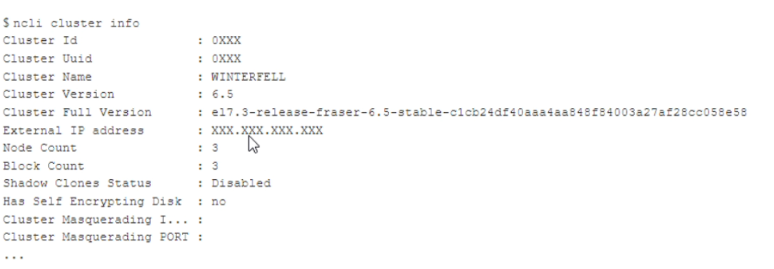
An administrator plans to deploy a VMWare Horizon Solution on AHV. The administrator used the cluster command to verify if Shadow Clones are enabled in the AHV environment. This command shows the following output:
Which action should the administrator take to enable Shadow Clones?
○
AConnect to the AHV Host by SSH.
○
BExecute the acluster edit-prams enable-shadow-clones=true command.
○
CConnect to Prism Central
○
DExecute the cluster enable --cluster_cluster_uuid 0xxx -- show_clones=true command.
NutanixNCP-EUC
Q3:
The administrator is reviewing Prism Central Tasks (Menu\Activity\Tasks) and noticed that there are a lot of tasks named:
ADS: Remove Resource Contention
The administrator would like to identify the virtual desktops in the environment that are using the most resources to determine how to fix the resource contention.
Which action should the administrator take to complete this task?
○
AReview the Storage Runway
○
BFilter the virtual desktops by Metrics: CPU Usage.
○
CFilter the virtual desktops by Constrained: High,
○
DReview Planning scenarios.
NutanixNCP-EUC
Q4:
An administrator is using a mix of full clones and nan-persistent desktops deployed via Citrix MCS on a three-node cluster. The full clone and non-persistent desktops are managed using separate storage containers.
Which two Storage Efficiency features will provide better storage efficiency and performance improvement? (Choose two.)