Related Certification(s):
Salesforce Architect Certification
Salesforce Plat-Arch-204 Exam Topics - You’ll Be Tested in Actual Exam
When you prepare for the Platform Integration Architect exam, start by learning how to evaluate the current system landscape in a structured way. You should be able to map the major systems, data sources, interfaces, volumes, and constraints, then spot risks like duplicated data, weak ownership, and fragile dependencies. Next, evaluate business needs by separating what stakeholders want from what the organization truly needs for outcomes such as accuracy, speed, compliance, and user experience. From there, translate needs to integration requirements by defining what data must move, how often, in which direction, and with what quality rules, along with nonfunctional needs like security, monitoring, and recoverability. Design integration solutions by choosing patterns that fit the scenario, such as request response for real time lookups, event driven messaging for decoupling, and batch for high volume processing, while planning identity, error handling, and transaction boundaries. Build the solution with a focus on reliability, testing, and clear operational ownership, making sure integrations are deployable and observable. Finally, maintain integration by setting up logging, alerts, and runbooks, reviewing performance trends, and evolving the design as systems and business priorities change, so the integration remains stable and trustworthy over time.
Salesforce Plat-Arch-204 Exam Short Quiz
Attempt this Salesforce Plat-Arch-204 exam quiz to self-assess your preparation for the actual Salesforce Certified Platform Integration Architect exam. CertBoosters also provides premium Salesforce Plat-Arch-204 exam questions to pass the Salesforce Certified Platform Integration Architect exam in the shortest possible time. Be sure to try our free practice exam software for the Salesforce Plat-Arch-204 exam.
Universal Containers (UC) is planning to implement Salesforce as its CRM system. Currently, UC has the following systems:
Leads are managed in a Marketing system.
Sales people use Microsoft Outlook to enter contacts and emails, and manage activities.
Inventory, Billing, and Payments are managed in UC's Enterprise Resource Planning (ERP) system.
The proposed CRM system is expected to provide sales and support people with a single view of their customers and the ability to manage their contacts, emails, and activities in the Salesforce CRM.
What should an integration architect consider to support the proposed CRM system strategy?
○
AEvaluate current and future data and system usage, and then identify potential integration requirements to Salesforce.
○
BPropose a middleware system that can support interface between systems with Salesforce.
○
CExplore out-of-the-box Salesforce connectors for integration with ERP, Marketing, and Microsoft Outlook.
SalesforcePlat-Arch-204
Q2:
A company needs to send data from Salesforce to a homegrown system behind a corporate firewall. The data is pushed one way, doesn't need to be real-time, and averages 2 million records per day. What should an integration architect consider?
○
ADue to high volume of records, number of concurrent requests can hit the limit for the REST API.
○
BDue to high volume of records, the external system will need to use a BULK API Rest endpoint to connect to Salesforce.
○
CDue to high volume of records, a third-party integration tool is required to stage records off platform.
SalesforcePlat-Arch-204
Q3:
The goals for implementing Salesforce include a 360-degree view, leveraging CRM for marketing, sales, and service, and reusing enterprise quoting/order management. Which three systems from the current landscape can be retired?
○
AOrder Management, Case Management, and Email Marketing
○
BEmail Marketing, Sales Activity, and Case Management
○
CSales Activity, Order Management, and Case Management
SalesforcePlat-Arch-204
Q4:
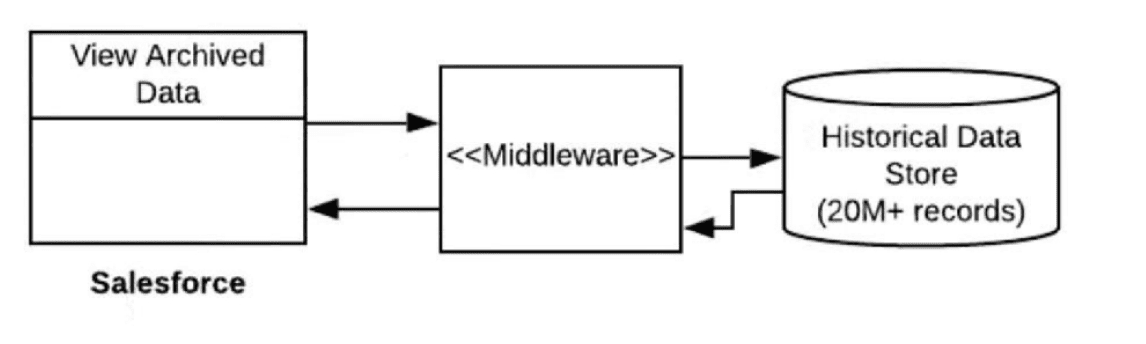
Given the diagram above, a Salesforce org, middleware, and Historical Data store exist with connectivity between them. Historical records are archived from Salesforce, moved to a Historical Data store (which houses 20 million records and growing), and fine-tuned to be performant with search queries. When reviewing occasional special cases, call center agents that use Salesforce have requested access to view the historical case items that relate to submitted cases.
Which mechanism and patterns are recommended to maximize declarative configuration?
○
AUse an ESB tool with a Data Virtualization pattern, expose the OData endpoint, and then use Salesforce Connect to consume and display the External object alongside the Case object.12
○
BUse an ESB tool with a Request and Reply pattern, and then make a real-time Apex callout to the ESB endpoint to fetch3 and display historical Data in a custom Lightning compo4nent related to the Case object.
○
CUse an ESB tool with a Fire and Forget pattern, and then publish a platform event for the requested historical data.
SalesforcePlat-Arch-204
Q5:
A new Salesforce program requires data updates between internal systems and Salesforce. Which relevant detail should an integration architect seek to solve for integration architecture needs?
○
ACore functional and non-functional requirements for User Experience design, Encryption needs, Community and license choices
○
BIntegration skills, SME availability, and Program Governance details
○
CTiming aspects, real-time/near real-time (synchronous or asynchronous), batch and update frequency