Available Number of Questions: Maximum of
94 Questions
Exam Name: WGU Applied Algebra FXO2 PFXP C957
Related Certification(s):
WGU Courses and Certification
WGU Applied Algebra Exam Topics - You’ll Be Tested in Actual Exam
In this course, you will spend most of your time translating real algebra skills into reliable exam steps. Start by getting comfortable with algebraic expressions and operations, since you must simplify correctly by combining like terms, using the distributive property, and handling fractions and negative signs without losing accuracy. From there, linear equations and inequalities become your everyday tools. You should solve for a variable using inverse operations, keep track of equality, and remember that multiplying or dividing an inequality by a negative number flips the sign. Graphing and functions build on that foundation. Practice reading and creating graphs of lines, finding slope and intercepts, and connecting equations to their visual meaning. Also know what makes a relation a function and how to evaluate function notation by substituting inputs. Systems of equations ask you to find where two lines meet, so be ready to use substitution or elimination and interpret the solution as an ordered pair, or recognize when there are no solutions or infinitely many. Exponents and polynomials round out the essentials. Apply exponent rules to simplify expressions, and add, subtract, and multiply polynomials carefully while keeping track of degree and like terms. When these skills work together, problems feel more predictable and your results make sense.
WGU Applied Algebra Exam Short Quiz
Attempt this WGU Applied Algebra exam quiz to self-assess your preparation for the actual WGU Applied Algebra FXO2 PFXP C957 exam. CertBoosters also provides premium WGU Applied Algebra exam questions to pass the WGU Applied Algebra FXO2 PFXP C957 exam in the shortest possible time. Be sure to try our free practice exam software for the WGU Applied Algebra exam.
1of 0 questions |
WGU Applied Algebra Exam Quiz
✓ 0 answered
🔖 0 bookmarked
WGUApplied Algebra
Q1:
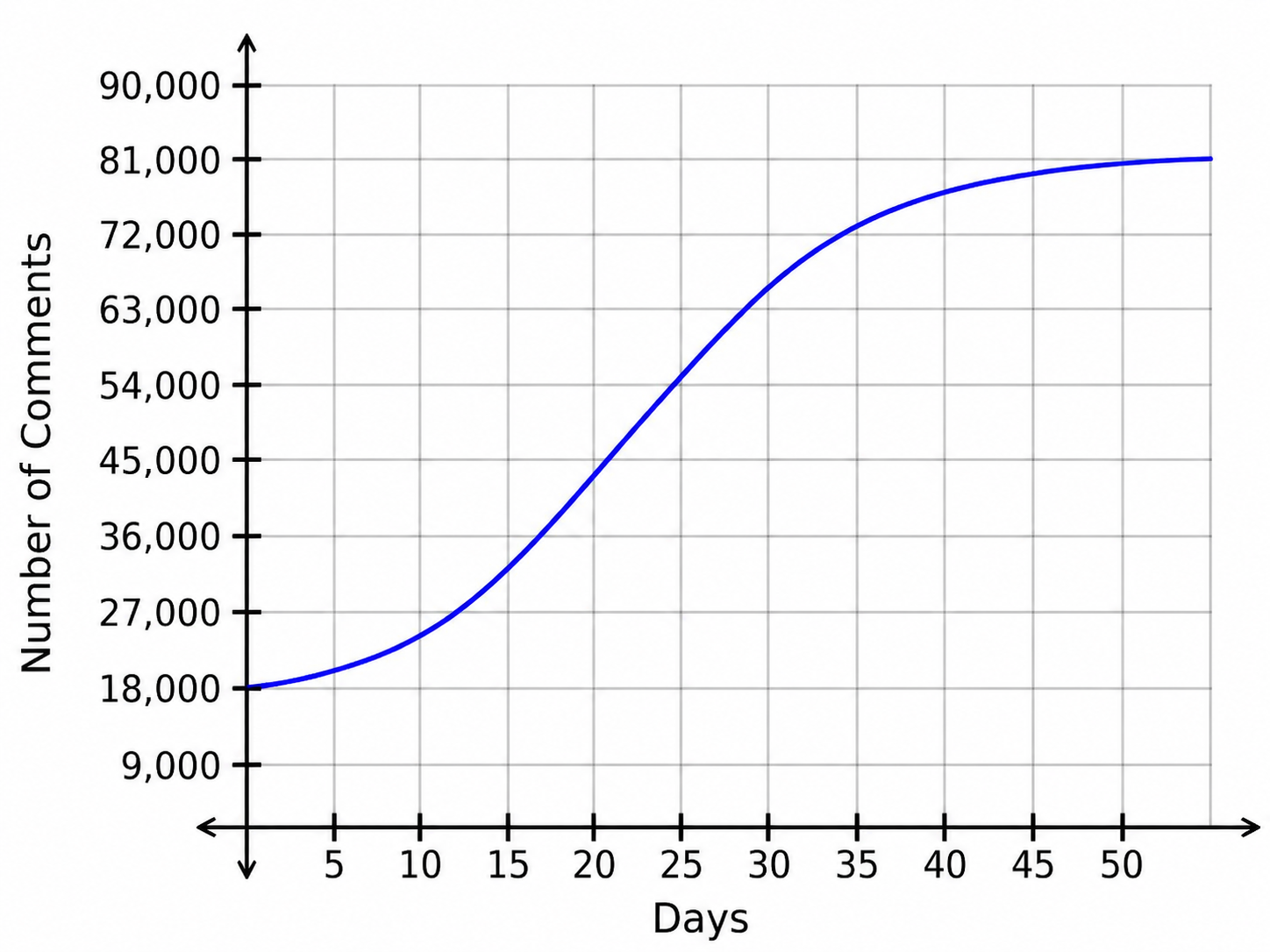
The number of acres affected by an invasive species can be modeled using the logistic function , where represents the number of months since the species was introduced and represents the number of affected acres. The graph of is shown.
What happens as time progresses from month 2 to month 6?
○
AThe number of affected acres increases slower and slower.
○
BThe number of affected acres increases faster and faster.
○
CThe number of affected acres decreases slower and slower.
○
DThe number of affected acres decreases faster and faster.
WGUApplied Algebra
Q2:
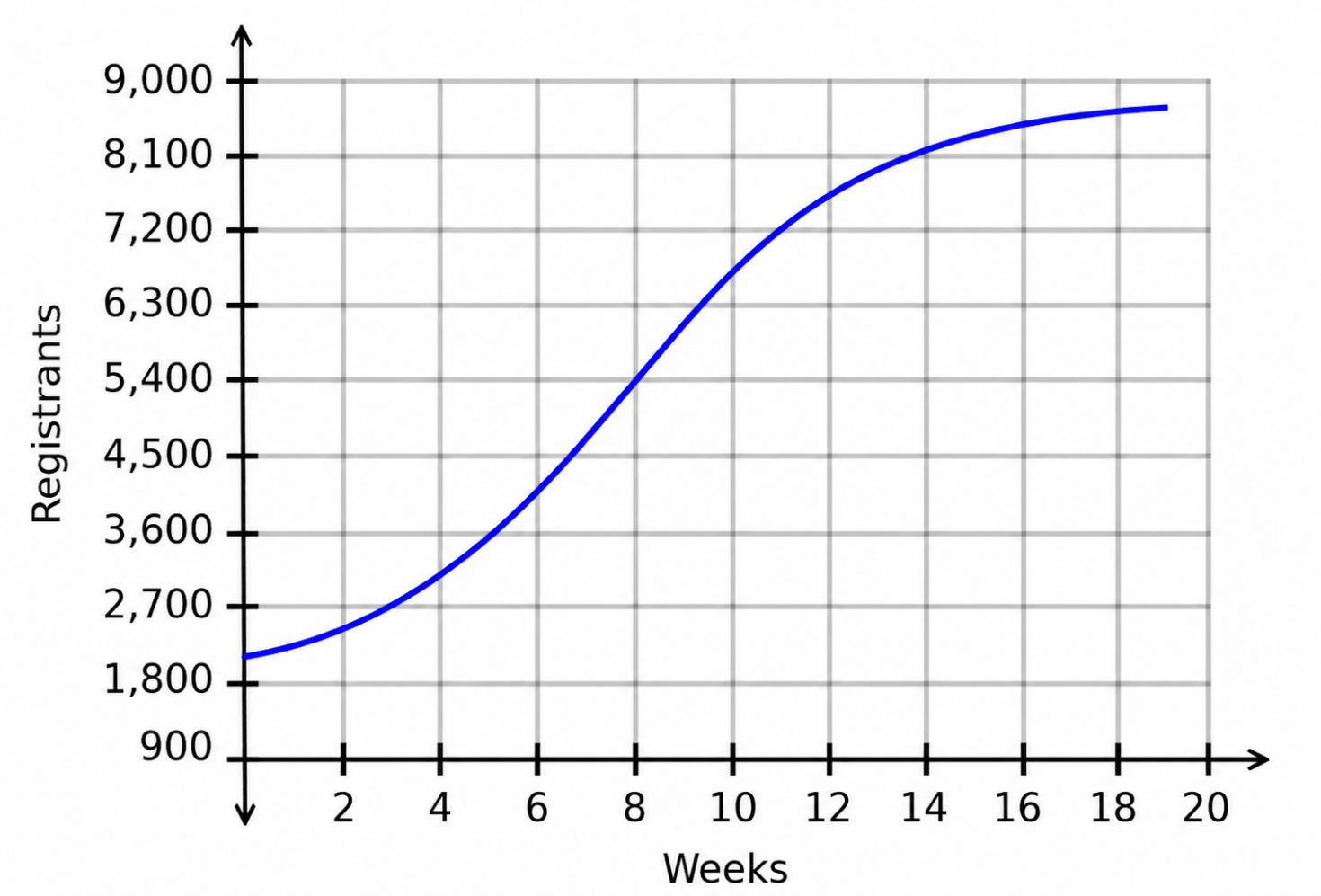
The logistic function , whose graph is shown, models the number of registrants for an academic conference, where represents the number of weeks since registration opened and represents the number of registrants.
How does the number of registrants change as time progresses from week 1 to week 7?
○
AThe number of registrants decreases slower and slower.
○
BThe number of registrants increases faster and faster.
○
CThe number of registrants increases slower and slower.
○
DThe number of registrants decreases faster and faster.
WGUApplied Algebra
Q3:
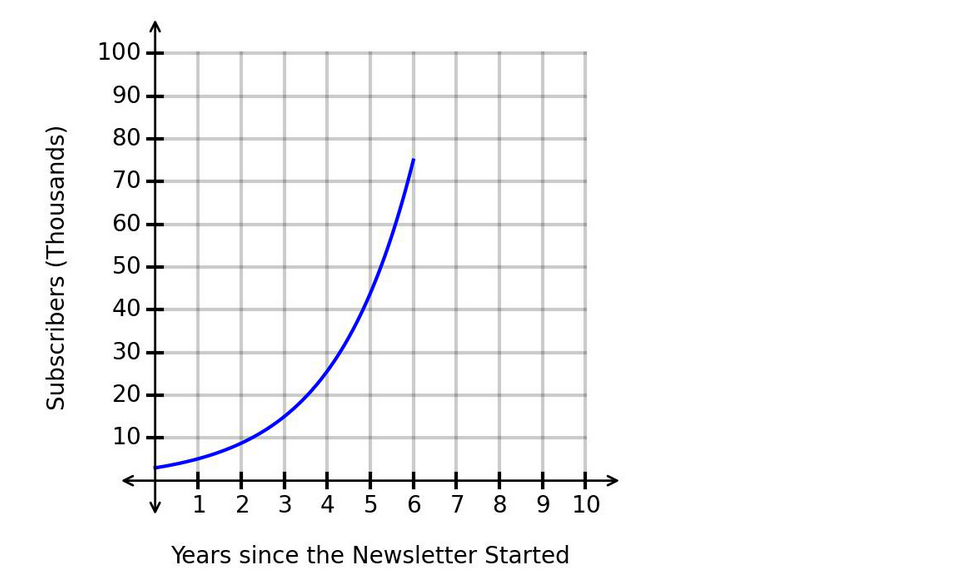
The function models the number of subscribers to a virtual newsletter over time. The graph of is shown. The horizontal axis represents the number of years since the newsletter started, and the vertical axis represents the number of subscribers, in thousands.
How is the number of subscribers changing over time based on the graph?
○
AThe number of subscribers is increasing faster and faster.
○
BThe number of subscribers is decreasing slower and slower.
○
CThe number of subscribers is increasing slower and slower.
○
DThe number of subscribers is decreasing faster and faster.
WGUApplied Algebra
Q4:
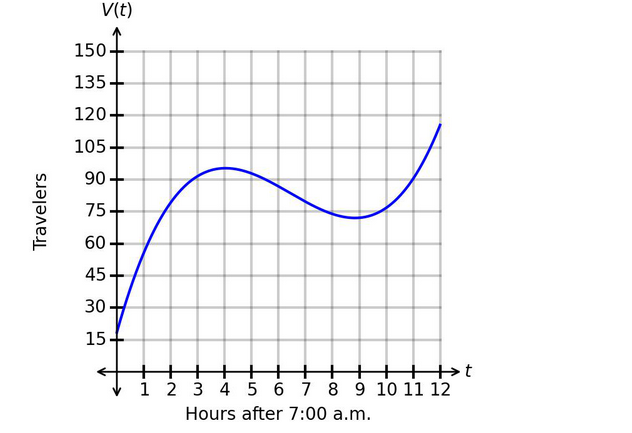
The function represents the number of travelers, , in a travel depot hours after 7:00 a.m. The graph of is shown.
What does represent?
○
A2 hours
○
B2 travelers
○
C79.2 hours
○
D79.2 travelers
WGUApplied Algebra
Q5:
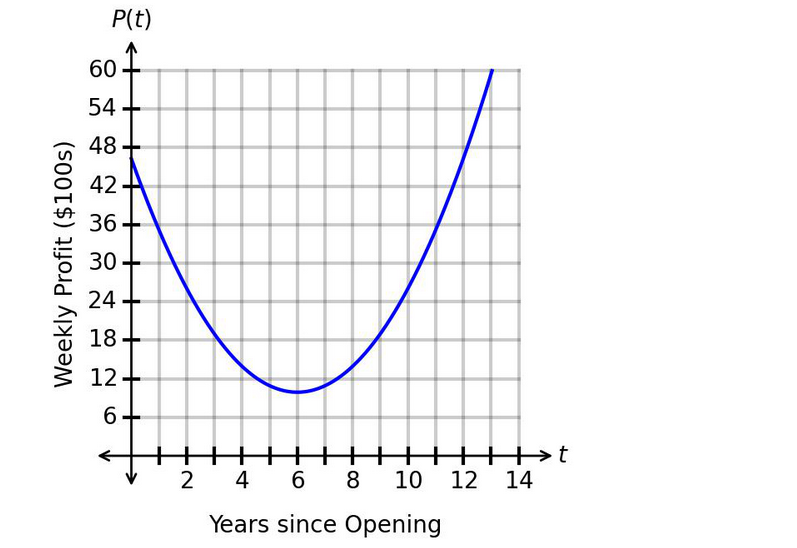
The graph shows the weekly profit in hundreds of dollars for a coffee shop. The horizontal axis represents the number of years since the coffee shop opened.
What is the correct interpretation of the minimum value?
○
AApproximately 6 years after opening, a minimum weekly profit of approximately was earned.
○
BApproximately 13 years after opening, a minimum weekly profit of approximately was earned.
○
CApproximately 6 years after opening, a minimum weekly profit of approximately was earned.
○
DApproximately 13 years after opening, a minimum weekly profit of approximately was earned.