Related Certification(s):
WGU Courses and Certification
WGU Integrated Physical Sciences (MTC1) Exam Topics - You’ll Be Tested in Actual Exam
The WGU Integrated-Physical Sciences exam is a comprehensive assessment designed to evaluate your understanding of various scientific principles and their applications. This exam covers an extensive range of topics, including the fundamental concepts of matter and energy, their interactions, and the laws that govern them. You'll delve into the fascinating world of atoms, molecules, and chemical reactions, exploring how these building blocks of life behave and interact. Additionally, the exam explores the dynamics of forces, motion, and energy transfer, providing insights into the physical world around us. Furthermore, it covers the vast expanse of the universe, from the origins of the cosmos to the behavior of celestial bodies, offering a glimpse into the mysteries of the night sky. The exam also delves into the intricacies of electricity and magnetism, unraveling the principles that power our modern world. By understanding the behavior of waves and particles, you'll gain insights into the fundamental nature of light and sound. Lastly, the assessment covers the crucial topic of heat and thermodynamics, exploring the transfer and transformation of energy, and their impact on our daily lives. With a comprehensive approach, the WGU Integrated-Physical Sciences exam aims to provide a holistic understanding of the physical world, connecting the dots between various scientific disciplines and offering a profound appreciation for the wonders of nature.
WGU Integrated Physical Sciences (MTC1) Exam Short Quiz
Attempt this WGU Integrated Physical Sciences (MTC1) exam quiz to self-assess your preparation for the actual WGU Integrated Physical Sciences (MTC1) exam. CertBoosters also provides premium WGU Integrated Physical Sciences (MTC1) exam questions to pass the WGU Integrated Physical Sciences (MTC1) exam in the shortest possible time. Be sure to try our free practice exam software for the WGU Integrated Physical Sciences (MTC1) exam.
In which scenario does gravity cause the change in the object's motion?
○
AA truck coming to a stop after applying the brakes
○
BA skydiver accelerating towards the ground after jumping from a plane
○
CA book sliding across a table after being pushed by someone
○
DA speed skater accelerating across the ice after the starting gun
WGUWGU Integrated Physical Sciences (MTC1)
Q2:
While listening to the morning weather report, a scientist hears that a low pressure system is settling over the area.
How should the scientist prepare for the day's weather?
○
ABring extra water and prepare for very hot, humid weather.
○
BWear warm clothes and bring sunglasses to prepare for cold, sunny weather.
○
CDress in lightweight clothing and apply a lot of sunscreen to prepare for hot, sunny weather.
○
DBring an umbrella and wear waterproof shoes to prepare for cloudy, rainy weather.
WGUWGU Integrated Physical Sciences (MTC1)
Q3:
What energy conversion takes place when a ball rolls up a ramp?
○
AKinetic energy is converted into gravitational potential energy.
○
BGravitational potential energy is converted into kinetic energy.
○
CChemical potential energy is converted into gravitational potential energy.
○
DElastic potential energy is converted into thermal energy.
WGUWGU Integrated Physical Sciences (MTC1)
Q4:
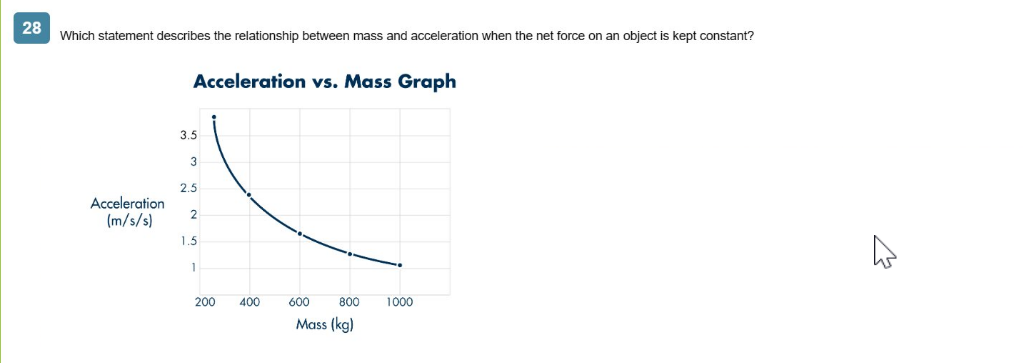
Which statement describes the relationship between mass and acceleration when the net force on an object is kept constant?
○
AMass and acceleration are not correlated.
○
BMass and acceleration are inversely proportional.
○
CMass and acceleration are directly proportional.
○
DMass and acceleration are quadratically related.
WGUWGU Integrated Physical Sciences (MTC1)
Q5:
In 2011, scientists reported on an experiment in which neutrinos appeared to travel faster than light. This result was remarkable because it violates Einstein's theory of special relativity, which has been a cornerstone of our understanding of physics since 1905.
What is the appropriate scientific approach for dealing with this contradiction?
○
ACheck the experimental setup and try to replicate the results
○
BChange the new data to show speeds lower than the speed of light
○
CAbandon Einstein's theory because it has been proven invalid
○
DIgnore the new data because it contradicts Einstein's idea